


The relationship between private and public markets has evolved over the past two decades. While initial public offerings (IPOs) once provided investors access to companies

Deciphering 10b5-1 Plans For Company Employees
Published Date : October 23, 2026
Rule 10b5-1 trading plans have garnered more attention in recent months as some high-profile IPOs have occurred or are rumored to be coming soon. But what exactly are these specialized trading plans? 10b5-1 plans can help corporate executives, company insiders, and employees with access to material nonpublic information (MNPI) sell company stock in a structured and disciplined way while reducing the risk of insider trading allegations. It is a written arrangement that establishes in advance how and when an individual will trade company stock. Under Securities and Exchange Commission (SEC) rules, a properly established plan may provide an affirmative defense against insider trading allegations, provided all applicable requirements are met. This can be particularly relevant for employees whose equity compensation includes restricted stock units (RSUs) or stock options, which can represent a substantial portion of their overall wealth.
From a wealth management perspective, a 10b5-1 plan should be considered as part of a broader financial strategy. Selling company stock can affect capital gains taxes, portfolio diversification, charitable giving, and future liquidity needs. Coordinating a trading plan with an individual’s overall financial goals can help ensure that decisions around equity compensation support their long-term financial well-being.
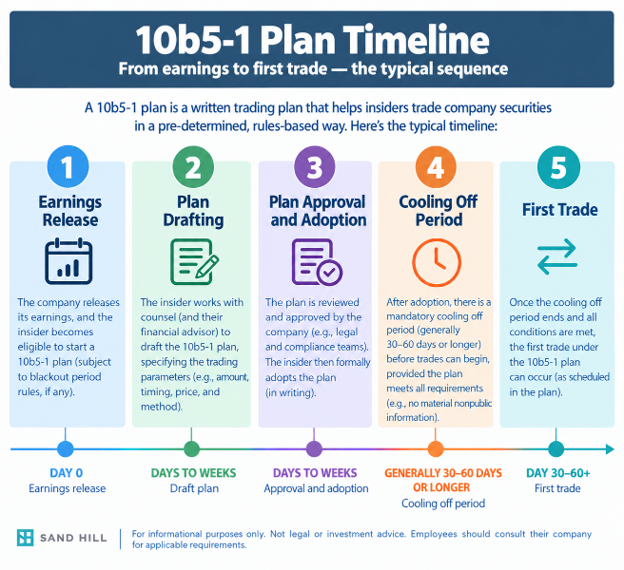
Establishing a plan requires careful timing and preparation. Generally, because an individual must adopt the plan when they are not in possession of MNPI, these plans are often established during a company’s open trading window. Employees and insiders must also act in good faith, including making the required certification at adoption that they are not aware of MNPI and are not adopting the plan as part of a strategy to evade Rule 10b-5. The plan must meet applicable requirements for specifying the amount, price, and timing of trades, or establish a formula for determining those details. Once the structure is approved by company counsel and the trading broker, it can be signed and adopted by all parties.
After adoption, a mandatory cooling-off period applies before trading can begin. For directors and officers, this period is generally longer, such as the later of 90 days after adoption or modification of the plan, or two business days following the filing of the company financial reports for the fiscal quarter in which the plan was adopted or modified (up to a maximum of 120 days). For other individuals, the required cooling-off period is generally 30-60 days. Companies may also impose additional restrictions. Once the cooling off period ends, trades are then carried out in accordance with the plan’s terms, typically through a designated broker and subject to oversight by the company’s legal counsel.
Changes to an existing plan require careful consideration, as modifications may be treated as the adoption of a new plan and trigger additional requirements or cooling-off periods. Other limitations may also apply, including restrictions on overlapping plans and limits on single-trade plans. Because the rules can vary depending on an individual’s role and the structure of the arrangement, it is important to review the applicable requirements with the company’s legal or compliance team before proceeding.
A 10b5-1 plan is not a guarantee of legal protection, and it should be developed with input from qualified legal, tax, and financial professionals. When thoughtfully implemented, it can be a useful tool for managing company stock, reducing concentrated investment risk, and supporting long-term financial goals. Sand Hill’s wealth managers often work with clients to incorporate 10b5-1 plans into their broader financial strategies, helping them approach equity compensation, diversification, and long-term wealth management with greater clarity and confidence.
Source: SEC
Articles and Commentary
Information provided in written articles are for informational purposes only and should not be considered investment advice. There is a risk of loss from investments in securities, including the risk of loss of principal. The information contained herein reflects Sand Hill Global Advisors' (“SHGA”) views as of the date of publication. Such views are subject to change at any time without notice due to changes in market or economic conditions and may not necessarily come to pass. SHGA does not provide tax or legal advice. To the extent that any material herein concerns tax or legal matters, such information is not intended to be solely relied upon nor used for the purpose of making tax and/or legal decisions without first seeking independent advice from a tax and/or legal professional. SHGA has obtained the information provided herein from various third party sources believed to be reliable but such information is not guaranteed. Certain links in this site connect to other websites maintained by third parties over whom SHGA has no control. SHGA makes no representations as to the accuracy or any other aspect of information contained in other Web Sites. Any forward looking statements or forecasts are based on assumptions and actual results are expected to vary from any such statements or forecasts. No reliance should be placed on any such statements or forecasts when making any investment decision. SHGA is not responsible for the consequences of any decisions or actions taken as a result of information provided in this presentation and does not warrant or guarantee the accuracy or completeness of this information. No part of this material may be (i) copied, photocopied, or duplicated in any form, by any means, or (ii) redistributed without the prior written consent of SHGA.
Video Presentations
All video presentations discuss certain investment products and/or securities and are being provided for informational purposes only, and should not be considered, and is not, investment, financial planning, tax or legal advice; nor is it a recommendation to buy or sell any securities. Investing in securities involves varying degrees of risk, and there can be no assurance that any specific investment will be profitable or suitable for a particular client’s financial situation or risk tolerance. Past performance is not a guarantee of future returns. Individual performance results will vary. The opinions expressed in the video reflect Sand Hill Global Advisor’s (“SHGA”) or Brenda Vingiello’s (as applicable) views as of the date of the video. Such views are subject to change at any point without notice. Any comments, opinions, or recommendations made by any host or other guest not affiliated with SHGA in this video do not necessarily reflect the views of SHGA, and non-SHGA persons appearing in this video do not fall under the supervisory purview of SHGA. You should not treat any opinion expressed by SHGA or Ms. Vingiello as a specific inducement to make a particular investment or follow a particular strategy, but only as an expression of general opinion. Nothing presented herein is or is intended to constitute investment advice, and no investment decision should be made based solely on any information provided on this video. There is a risk of loss from an investment in securities, including the risk of loss of principal. Neither SHGA nor Ms. Vingiello guarantees any specific outcome or profit. Any forward-looking statements or forecasts contained in the video are based on assumptions and actual results may vary from any such statements or forecasts. SHGA or one of its employees may have a position in the securities discussed and may purchase or sell such securities from time to time. Some of the information in this video has been obtained from third party sources. While SHGA believes such third-party information is reliable, SHGA does not guarantee its accuracy, timeliness or completeness. SHGA encourages you to consult with a professional financial advisor prior to making any investment decision.
Recent Posts